





Many pray at the altar of skincare, but few have a fervent following quite like Dieux Skin. What makes the brand so worship-worthy? A holy trinity of science, transparency, and community, underpinned by a powerhouse trio of founders.
Head of Product, Joyce de Lemos, previously worked as a skincare chemist at L’Oréal and Lead Formulation Chemist in Skincare at Function of Beauty. Charlotte Palermino, CEO, the former Editorial Director of Snap Inc.’s Discover platform, knows what it takes to gain and sustain consumer attention. Marta Freedman, Creative Director and founder of digital advertising agency Air Milkshake, understands the power of effective branding.
The brand idea took root when Palermino and Freedman (who met through Freedman’s Instagram project, Hot Girls Eating Pizza) created a cannabis newsletter, Nice Paper, amid the CBD hype wave. This began their interest in seeing the ingredient’s potential for skincare. Eager to find a cosmetic chemist who could give them input, they were connected to de Lemos through a contact of Palermino. The three had an instant creative synergy and their substantiation work saw no limits with cannabinoids. They wanted that type of validation and truth-telling in the skincare space too.
In September 2020, they launched with Forever Eye Mask, which became a viral hit on social media. Made of medical grade silicone, the product allows for better absorption of skincare products into the eye area, but like all Dieux Skin products has a sustainability component in mind. Thanks to a Bluebird Climate sustainability analysis of the product shows that daily use for a year (compared to disposable eye masks) saves 37.8kg of carbon, 3.1kg of waste, and 1.4kg of plastic waste. When it comes to the packaging of its other products, Dieux Skin prioritizes recyclable and reusable packaging, with biquarterly reviews of its packaging to evaluate any potentially more eco-friendly swaps.
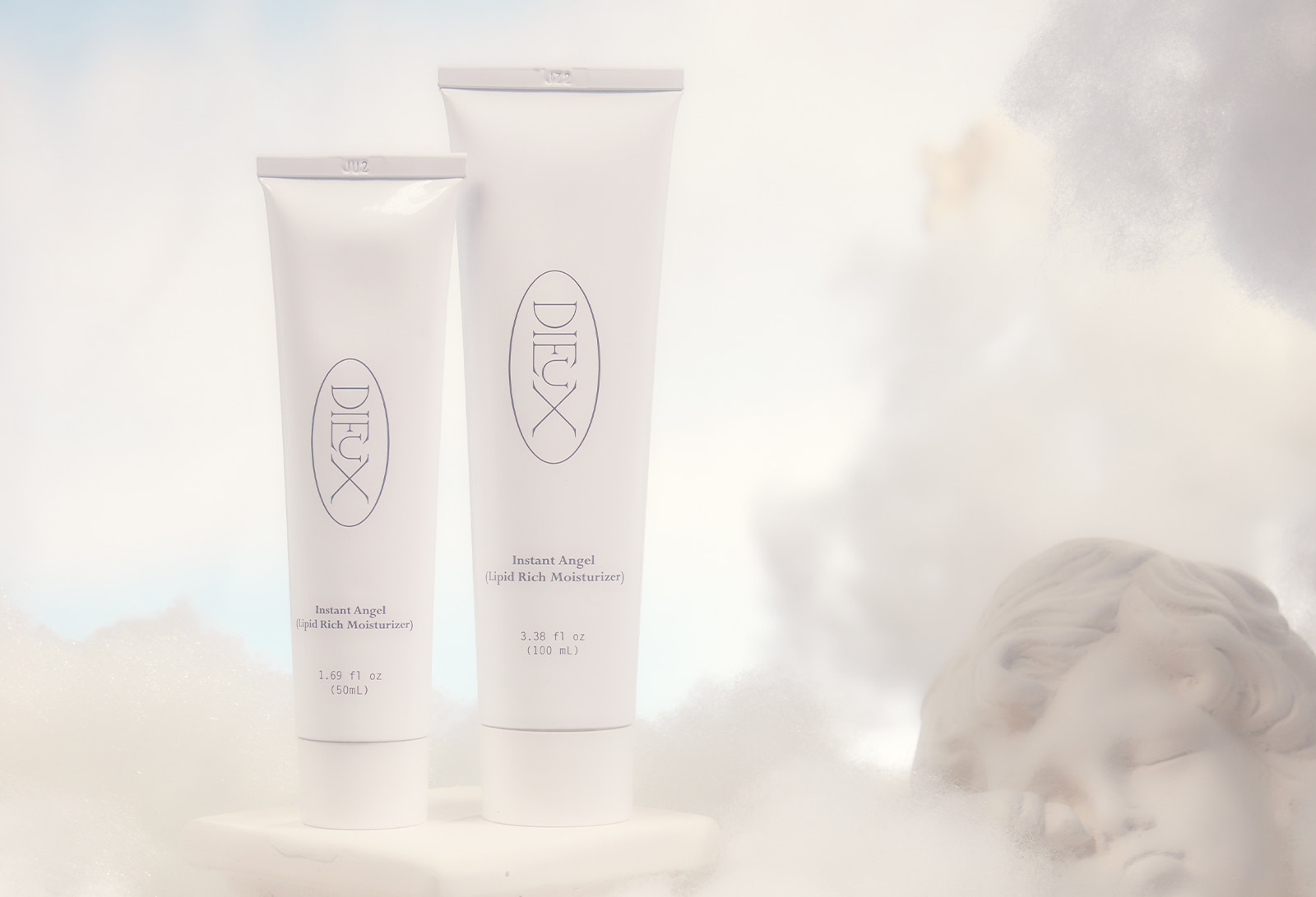
Next came ethereally named products (with the science credentials to match) like Instant Angel Moisturizer, a skin barrier protecting and unfragranced formula with phytosterols, meadowestolide, and urea, and Deliverance, a serum which treats irritation, uneven tone, and fine lines with a proprietary 1% encapsulated cannabinoid complex, 3% water lily complex, 2% n-prolyl palmitoyl tripeptide-56 complex, 3% palmitoyl hexapeptide-52 complex, and 4% niacinamide.
In the case of the aforementioned cannabinoid complex, an ingredient that has little studies in terms of skincare efficacy, Dieux Skin engaged a single blind clinical study by a third-party research group. Using 20 participants, the brand evaluated the efficacy of three doses of its complex to reduce inflammation. They found the lowest dose to be the most effective, bringing inflammation signs back to baseline in five days with a once-daily application.
Air Angel Gel Cream, the brand’s hydrating, plumping, and firming formula for oily and acne prone skin, was put through a third-party clinical RIPT (Repeat Insult Patch Test) via a vapometer and corneometer. The product was found to be noncomedogenic, nonacnegenic, and nonsensitizing when applied twice daily for 30 days. Skin also retained moisture for 12 hours after initial application.
When it comes to numbers, price transparency is another core pillar of Dieux Skin’s mission for demystification. On their website, the brand breaks down the total production costs, payment processing, shipping, markup, and retail price.
The brand is equally transparent about their philanthropic and environmental causes. Dieux Skin regularly donates to enterprises such as Fair Fight, a voter mobilizing organization, and also has designated donations for certain products. One dollar of every sale of Instant Angel supports reproductive justice organizations; $1 of Air Angel supports the Union of Concerned Scientists fighting the climate crisis; and $1 of every sale of Deliverance supports the Floret Coalition, an antiracist collective funding equity-focused campaigns and supporting small businesses. Ten percent of every purchase of its Forever Eye Mask goes towards In The Making, a community resource center in Los Angeles offering not only clothes, household goods, and toiletries to those in need but also training young people in life and work skills to set them up for a better future.
That generosity is being reciprocated, with Dieux Skin achieving 45% growth in the last year and 430% year-over-year growth. Deliverance sold out five times and has a 14,000 member-long waitlist. One tube of Instant Angel is purchased every five minutes. Dieux Skin has also been building a budding community of 122,000 followers on Instagram and 84,700 followers on TikTok, with content debunking popular skincare topics like sunscreen safety and retinol sensitivity. Thanks to its resounding success, the brand has extended from a DTC-only presence to launching on the Sephora site and in stores in February and March of this year.
BeautyMatter sat down with Palermino to discuss the brand’s evolution, why efficacy trumps newness when it comes to ingredient innovation, and broaching controversial territories in the skincare arena.
The brand has such a powerful trio of founders. Where does the strength of your founding team versus the brand vision come in when creating a successful brand?
I think not having an overlap is really important. Everybody has their superpower and moves forward with that. That's what helps create a strong brand.
The roots of the brand started in CBD. I'm curious to hear your thoughts on the evolution of that category.
It started in understanding marketing; what actually works and what doesn't work. CBD started with great intentions; people were so excited about the category, but a lot of CPG brands were created that came out before the science was out. I'm a huge fan of cannabis; it's incredible. Especially as a sleep aid, it has incredible promise. But was it the cure-all? No. That’s where marketers can sometimes lead categories off the deep end because there's a general mistrust with CBD. In reality, it has incredible potential for calming and soothing the skin and also potentially even calming your nervous system. But you need to understand that dosage for your endocannabinoid system. There's also more research needed about if you need multiple cannabinoids because THC and CBD are one of hundreds of cannabinoids in that plant.
When the brand launched, it felt that it was speaking to a lot of the confusion in the skincare space that was happening at the time. People were moving away from this idea of 10-step skincare routines. But launching during the pandemic also undoubtedly came with a lot of challenges.
I was getting my esthetician license, I signed up for that before the pandemic started. I knew I was getting into skincare and wanted to have a greater understanding of what happens with your skin and what skincare can actually do.
Sometimes consumers don't understand that all that skincare is legally allowed to operate on is that top layer of skin, the stratum corneum. When you start talking about ingredients like retinol, you're technically not supposed to be saying collagen responds because it then goes into the dermis, which is second layer. Esthetician school is that first foray for me into understanding the beauty of skincare and what skincare can do but also what it can't do. What it can't do is as important as what it can do. That's what informed my philosophy when it comes to skincare and the amount of steps you need.
Now, that's actually a very broad category as well, because just like with food, some people eat to live, other people live to eat. It's the same thing with anything in any category. Some people love being maximalists. When you're looking at 12-step skincare regimens—first off, if you look at Korean beauty, they don't have 12-step routines; that's an Americanization. Korean beauty practices are actually very simple and very focused on barrier repair, at least for the people that I speak with. They do a lot of spas and dermatological treatments that are focused on simplicity and barrier repair. Even if you're going to be buying something like a retinol, it's going to be a tretinoin or very gentle. That’s where I've gotten different inspirations.
Something that struck me too is how each each product launch is tackling multiple aspects That ties into the idea of being a sustainable brand—it isn't just what packaging do you use, but are you pumping out product just for the sake of product versus being very precise on that? How do you go about that creation process, determining what the next big thing is you need to give to your audience?
There always needs to be a true differentiation with the product in order for us to launch it; otherwise we put a pin in it. If there's something that already exists, at the price point that you're creating it, do you need to launch it? That's the big question and our guiding philosophy.
TikTok virality was also a big partof the company's growth. How do you navigate that, and what are the pros and cons of that happening?
We talked about this a lot internally; your marketing costs are incredibly low. The reality for any brand is that you have that potential. A lot of brands, when they are created, have constant investment dollars and ideas around customer acquisition costs. When your customer acquisition costs are under $1, you're operating at a totally different ballgame. That is the pro. The con is: Can you keep it up?
How do you go about choosing the creators and influencers in the space you work with? Or is it a lot of organic word-of-mouth growth?
We're really lucky. We did we have a lot of organic word-of-mouth and then also a lot of affiliate programs. That's something we're very open about.
What made Sephora the right retail partner, and why was it the right time to shift from having been exclusively DTC toin-store retail?
We've always believed in omnichannel as the path to ultimate growth. Sephora is really focused on education and so for us, that kind of partnership where it put so much investment and resources into its beauty advisors was really what interested us. Also people go there for discovery. We're still a small brand comparatively to other brands so discovery and education is everything.
Debunking a lot of skincare or ingredient myths has been a core part of the business. The misinformation exists on so many levels—on a consumer level, but sometimes even within a founder level. What would be the key area dispelling a lot of those myths?
I'm a deeply practical person. Particularly when you look at our audience—we obviously have some younger consumers, I don't think we have Gen Alpha quite yet, nor do I want that market because they're fine with just sunscreen—it’s about honesty and taking away the blame from people. There's so much shame put on women. We praise women that look much younger than their age, but it's usually a combination of genetics, wealth, and how hard they're working. But if you show that you've worked hard, then you get shamed for that too. Talking about that complexity, especially as you get older, it's really refreshing. If you have the right price point and the product works, that's why people come back. That’s generally my philosophy on it, and I'm always really excited about new research and new ingredients, but I'm extremely wary of anybody who uses fear to motivate an action.
You also practice price transparency, which is very new for a brand to do. Why did that become a core pillar of Dieux Skin?
There are so many brands that are launching on the market at a variety of price points. As somebody who's coming in more from the marketing and writing side, having written about beauty for publications, you don't really understand why some creams are $300 and others are $4. It's like a black box. For me, anything that's taboo is something that we have to talk about. Why do we feel uncomfortable to talk about it? If there is this incredible science and technology in your product then let's talk about that. When we were creating the products and I saw the raw cogs, it was more expensive than I thought it was going to be because of the quality, price, but also the volumes in which we were buying it. The thing we're really open about is, if you get to international distribution and you're creating millions of units, number one, that's where I get nightmares about plastic, but number two, the other piece is your economies of scale. Your costs go down. We're not there yet, but it's something to consider.
When I was looking at all that I saw, there's the formula cost, there's the packaging cost, but where's the cost for labor? Where's the costs for all the other things? It's never just the formula price. I could say there's a 10x markup on the formula. Well, do we think that faeries are filling these products? No, humans are doing it. You pay a warehouse, a contract manufacturer; you're also paying for IP, the machinery, for it to be shipped back and forth. There are humans doing that labor as well. So while some markups are not something I would personally be comfortable with as my brand—I can't speak to what they're paying their employees—if you're charging $3 for a moisturizer, you're paying people double the going rate for their role; then, nobody would be mad working at that company. It's all about perspective. We have to have healthy margins selling in Sephora, but our moisturizer is never going to be that goop that you get. It's the packaging it comes in, and the people that help get it there.
What have been the most controversial topics in our industry? Is there anything that stood out as causing a particular uproar?
What's so funny is that whatever is controversial becomes normalized. I do think there are a lot of moral panics. You're seeing it right now with Gen Alpha and Sephora; anyone that's concerned about teens and Sephora—do you not remember being a teenager? I was in Claire’s and all that eyeshadow had lead in it. It's very bizarre to me. Anything that was controversial is no longer controversial. That's the thing about how beauty is tied to culture. What was taboo shouldn't be taboo anymore. Probably 10 years ago, talking about diversity both in front of and behind camera was controversial. I worked in media; I saw what those newsrooms look like, and so it's interesting that now it's not taboo anymore. Now it's normalized.
Thewhole point of talking about things that are taboo is to normalize them. If we're supposed to be this free society that's inclusive, then shouldn't we be able to talk about things that are uncomfortable? Because the reason why you don't talk about things that are uncomfortable is because certain people are uncomfortable. Why is that? Let's talk about it. It doesn't mean that anything is going to necessarily change, particularly on the pricing front, but consumers can make more informed decisions. That's ultimately what I'm hoping for about anything I talked about. But the most controversial topic is sunscreen because anytime you bring the FDA to the chat, people get a little nervous. But things have to change.
You mentioned Sephora as the ideal partner because of the education factor, and also you have some great investors on board like True Beauty Ventures and Redo Ventures. Navigating the path of growing as a DTC brand, the choice of retail launch, and choice of investor can be crucial, so I would love to hear more about that.
We chose partners who have either run or built businesses before or have that deep institutional knowledge. We obviously have other investors as well but those are our main ones. The reality is, both of them have seen, grown, and scaled companies. When you're talking to them, it's not from a perspective of somebody who wrote us a check. It's from the perspective of you've done this before and you understand the highs and lows. They work very closely with their founders and are really helpful all around. Especially when you look at a company like Redo, they're giving you the knowledge they know from L’Occitane, which is one of the largest privately owned cosmetic brands.
What are your ambitions with the company looking to the future? Are there anypoints you want to hit or is it just continuing to cultivate the community, making great products, discussing the truth about skincare?
It's absolutely to be a brand that keeps growing, creating best-in-class formulas that don't necessarily exist. We want to challenge people's perceptions and ideas and poke holes in anything from a marketing perspective. The goal is eventually to change the industry and to make what we're doing normal. We have to keep evolving, so what is the next thing that we're going to tackle? Even in the three years since we've launched, there are a lot of brands that are starting to take on the language we use, but then it started to evolve and change. There's the next conversation that we have to move to; that's what happens when you're creating trends. That's the goal moving forward.
Regarding ingredients, obviously going into biotech and engineering a new ingredient is hugely time and resource-intensive. How do you manage to differentiate yourself above the standard ingredient palette?
We have developed our own ingredients and our own complexes of ingredients that we've studied as to how they work together. The cannabinoid complex being one of them that is proprietary to us. When you're looking at biotech ingredients, there are companies like Debut that are launching that are fantastic. They will work with you to create custom biotech ingredients. The scale to get to custom ingredients is going to be much more collapsed in the next 10 years than you would expect. Ultimately what I'm looking for is if that biotech ingredient is better than the ingredient that already exists on the market. Just because it's new and novel doesn't mean it's actually more efficacious.
I care more about if the formula is as efficacious as it can be at the best price that it can be in the most sustainable packaging that it can be. We're actually about to launch a product that has a biotech ingredient in it at 40%. It's a fun work-in-progress product that we're testing. I'm very excited about that. For me, it's always going to be about efficaciousness. New does not mean better. That's what we're looking at.
For retinoids, for example, there are new ingredients that are coming out that operate on different retinoic acid receptors. In your skin, you have these different retinoic acid receptors, and part of the reason why tretinoin works so well is because it works on so many of them, but it also creates a lot of irritation through that cell turnover. Is there a way to only target the receptor that stimulates collagen, elastin, and fibroblasts to basically plump out that skin but without that rapid cell turnover, where you can basically control where and when you want to have that cell turnover? Whether it be through glycolic acid or something else. My goal is always to get you the most efficacious product that can possibly be formulated at the best possible price that we can afford and in branding that makes you feel good. That's always going to be the ethos.
In terms of creating a loyal following, especially nowadays where it feels brand loyalty is a very different ballgame, what has been the key to cultivating your community?
The core of what we do is skincare, so having a skincare product that people want to buy again is paramount. You can have the best marketing and branding in the world, but if somebody does not like putting a product on their face, they are not going to come back. The core of it is creating these incredible products, obviously through the IP and the brilliant mind of Joyce, but then the other piece of that is how do you explain the product to people? How do you get them to understand it and whether it's for them or not? That's another thing that we say: This product is probably not for you if XYZ. The idea that that's bad to say is wild to me. You have to talk about who the product is and is not for. That's been one great way to cultivate trust, because we're actually trying to find people that the product works for versus saying this is a miracle for everyone.
I also think in the aspect of branding, a lot of times when you have these dermatology-led brands that visual identity will be a little bit more clinical. What your brand has done really well is, there’s obviously such seriousness and passion behind the formulas, but there’s a relatable way of channeling those things. Perhaps that's also why people enjoy engaging with the product and brand so much because you don't needa PhD to understand it, but at the same time, it's not a tub of petroleum jelly.
Exactly. We worked with designer Lee Schwartz, from PSA [Palmer Schwartz Agency] on a lot of our packaging, logo design, and font choices. It’s been so critical to how we approach the brand: the idea that it's clinical with soul.
When you started working on this concept versus today, what have been the biggest surprises?
The growth. I'm a very numbers-oriented person, and that's part of the reason we've been able to build the team that is focusing on that growth piece. When you start a business andrealize that people like it, you have to hire people to meet the demand. Then you have to maintain that demand to keep the people hired. It’s this cycle that starts happening very quickly. For me, it’s been an absolute honor and a privilege to have so many people trust the brand; to put the products we make and the packages we make on their faces. It's a very personal moment, and so it means a lot.